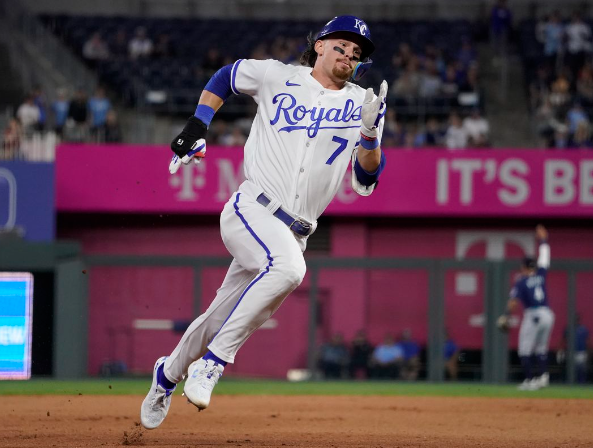
While speed isn’t necessarily the most crucial aspect of baseball, the new MLB rules adopted in 2023 have given speed much more importance in the game, and 10 players in particular have taken advantage. So here are the 10 fastest MLB players in 2025, according to Statcast sprint speed:
Bobby Witt Jr. :
30.5 Feet Per Second
Bobby Witt holds the highest sprint speed of any MLB player, and it’s easy to see why if you watch him play. When Witt Jr. entered the league, the hype surrounding the young shortstop was nothing short of enormous. And while his 2022 rookie season was fairly disappointing, the Royals’ former top prospect has, in time, blossomed into the star they had envisioned. In 2023, Bobby Witt Jr. recorded a 4th-highest number of stolen bases, which is further impressive considering how the three guys ahead of him got on base much more often than he did.
However, 2024 was Witt’s true breakout year, leading the MLB with a .332 batting average and a .977 OPS. While Witt’s offensive production has declined in 2025, he is on pace for a career-high stolen base total.
While Bobby Witt Jr‘s superhuman speed has massively increased his quality of play, Witt’s improved batting eye is really what made him an all-star and second in MVP voting in 2024. His walk percentage has doubled since his rookie year, and his strikeout percentage has gone from 21.4% to just 15%.

Johan Rojas:
30.1 Feet Per Second
Similarly to most of the first and second-year players on this list, Johan Rojas has used his speed to be a tremendously effective fielder but is still finding his footing at the plate.
During Rojas’s first substantial workload in 2024, the Phillies’ center fielder had a serviceable .243 batting average, with a disappointing three home runs in 120 games. And Rojas’s power hasn’t improved in 2025, recording just one home run in 67 games. Despite the Phillies having the 5th-most stolen bases in 2024, Johan Rojas was not a major contributor to that total, only stealing 13 bags in his sophomore year, and is on pace for a similar total in 2025.
Rojas is the second-fastest player in the MLB, but his 3.6% walk percentage makes his batting eye his most considerable area of improvement.

Dairon Blanco:
30.1 Feet Per Second
It’s unsurprising that the Royals have multiple players on this list, as the organization has always valued speedy players extremely highly for the past 10 years. That obsession has often served as a liability for the team, but that’s a different can of worms. Dairon Blanco doesn’t possess the same flashiness or hype that his teammate Bobby Witt Jr. does, but his generally solid contact hitting is a nice complement to Blanco’s eye-popping outfield skills. Five errors in three seasons in the MLB’s largest outfield is certainly nothing to scoff at.
Elly De La Cruz:
30.0 Feet Per Second
The Reds’ Elly De La Cruz is not only one of the MLB’s fastest players but also one of its most athletic players as well. De La Cruz’s 6’5 200 pound frame helps give him the 5th-highest arm velocity of any shortstop, in addition to leading the league in 90 feet sprint time. However, Elly De La Cruz’s insane athleticism often has a difficult time making up for his lack of fundamentals.
Starting with the defense, Cruz led the MLB in errors last season. Having a cannon for an arm is one thing, but controlling it is another. While the highlight reels and hype may tell a different story, Elly De La Cruz’s .250 career batting average makes him an objectively average hitter. Cruz’s power is easily noticeable, but leading the MLB in strikeouts has kept him from seriously competing in the annual home run race. Errors have slightly declined for De La Cruz in 2025, as well as a career-high .843 OPS thus far, showing that he is moving in the right direction.

Jonatan Clase:
30.0 Feet Per Second
It’s difficult to say much about Blue Jays left fielder Jonatan Clase. In his 2024 rookie season, he played just 26 games, and for two different teams. A good rule of thumb is that after about 100 at-bats, you have a sufficient idea of what kind of hitting season you’re having. After only 61 major league at-bats in 2024, Jonatan Clase has 100 in 2025, but his .210/.288/.300 batting line leaves a lot to be desired. While we know very little about Clase, we do know one thing: He’s a speed demon.
Victor Scott II:
30.0 Feet Per Second
Most players on this list have at least somewhat struggled hitting in their rookie seasons, and Victor Scott is no different. The Cardinals’ rookie center fielder has been a baseball magnet in the outfield but not so much at the plate. Scott recorded a .502 OPS, a .179 batting average below the Mendoza line, and a -0.5 WAR in 2024. After being promoted to a everyday player in 2025, Scott has improved as a sophomore, increasing his batting average in .234, OPS to .646, and WAR to 1.7. Scott’s average hitting in 2025 makes him a valuable plus starter thanks to his elite fielding.

Tyler Fitzgerald:
30.0 Feet Per Second
Tyler Fitzgerald is the MLB’s 5th-fastest player on the MLB’s slowest team. Although when a team averages 0.4 stolen bases per game, it’s not just the players that are slow, but the base coaches are also immensely unaggressive on the basepaths. Despite this unfortunate situation, Tyler Fitzgerald has utilized his speed in other areas of the game than stealing bases. Fitzgerald’s batting average on balls in play is .380. This means that Fitzgerald is exceptionally productive at turning rather difficult outs for infielders into infield base hits, reaching first base 10% more often when he hits the ball in play.
Nonetheless, Tyler Fitzgerald’s plate discipline is subpar at best and downright atrocious at worst. The Giants’ young shortstop ranks in the 4th percentile in strikeout % and the 12th percentile in whiff %. Lastly, the Giants have put Fitzgerald at seven different positions during his two-year MLB career, making his fielding quite challenging to track.

Pete Crow-Armstrong:
30.0 Feet Per Second
The title of “The tenth fastest MLB player” doesn’t sound particularly spectacular, but the 0.4 feet per second difference between the 1st and 10th fastest players is hardly noticeable without a timer. 2024 was Pete-Crow Armstrong’s first substantial Major League workload, recording a .237 batting average and 27 stolen bases in 123 games.
In 2025, Crow-Armstrong, has broken out from a player with mere potential to a legitimate superstar and an MVP candidate. Crow Armstrong leads the league with a WAR of 5.7 and is on pace for over 40 home runs at just 23 years old. The Cubs’ center fielder fits into the fielding-throwing-speed archetype that many players fall into and displays those three tools exceptionally well.
Jorge Mateo:
29.9 Feet Per Second
Orioles’ second baseman Jorge Mateo is the fastest second baseman in the MLB by a country mile. It’s honestly puzzling why the Orioles choose to put a rookie Gunnar Henderson at shortstop with the second-most errors behind Elly De La Cruz over a more experienced and consistent fielder in Jorge Mateo. Mateo had a rocky start to his career in 2020 with the Padres but quickly improved after being traded to Baltimore. Mateo has only played 184 games over the last two seasons due to injury, but he led the league in stolen bases in 2022 when he had a full season’s workload. Mateo also hit his career high in home runs during that same year, but Mateo’s -0.5 WAR and .180/.231/.279 batting line in 2025 puts his production far removed from that of his 2022 season.

Jose Siri:
29.9 Feet Per Second
At the ripe old age of 29, Jose Siri is easily the most senior player on this list. That’s extraordinarily impressive, considering that most MLB players start to lose their speed after their first few seasons. However, Jose Siri’s immense speed for his age isn’t the only puzzling aspect of his play. Siri ranks in the 1st percentile in strikeout % and whiff %, as well as batting below the Mendoza line, which is a beyond awful combination.
Nevertheless, Siri also ranks in the 94th percentile in barrel % and 70th percentile in sweet spot %. Essentially, Jose Siri hits the ball once in a blue moon but hits the sweet spot exceedingly often when he does. Siri’s fielding is rather straightforward, as his .987 career fielding percentage shows that teams keep him on the roster primarily for his elite defense.

Leave a Reply